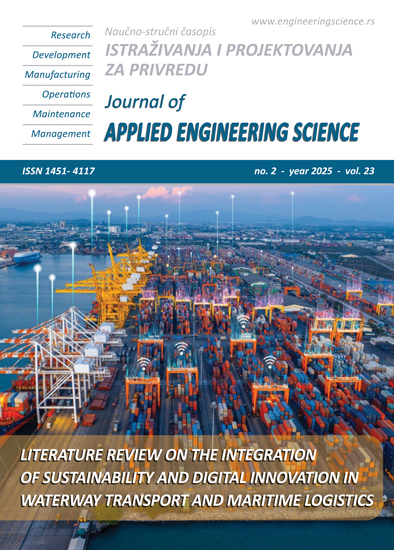
LITERATURE REVIEW: INTEGRATING SUSTAINABILITY AND DIGITAL INNOVATION IN WATERWAY TRANSPORT AND MARITIME LOGISTICS
Abstract
Modern waterway transport and maritime logistics industries are being transformed through sustainable practices combined with digital innovation which leads to better operational efficiency along with decreased environmental effects. Green technology adoption requires support from regulatory frameworks and financial incentives to meet emission reduction standards and promote investments in alternative fuels and energy-efficient solutions. IoT-enabled cargo tracking alongside blockchain supply chain transparency and AI predictive maintenance systems improve operational dependability through better resource management. Sustainable practices, including energy-efficient vessel design, route optimization, and shore power integration, contribute to lower fuel consumption and emissions. Smart ports and automated terminals streamline cargo handling, reducing energy use and improving supply chain efficiency. This study examines the relationship between regulatory policies, digital enablers, and sustainability strategies, demonstrating their collective impact on creating a more efficient and environmentally responsible maritime sector. This systematic review examines the intersection of sustainability and digital innovation in waterway transport and maritime logistics. Studies were sourced from Scopus, Web of Science, IEEE Xplore, ScienceDirect, and JSTOR, covering literature on supply chain efficiency, green technology, maritime logistics, inland waterway transport and digital transformation. A total of 52 studies met the inclusion criteria, focusing on regulatory policies, blockchain-enabled transparency, AI-driven predictive maintenance, and sustainable maritime and inland waterway operations. Findings highlight that digitalization enhances environmental sustainability while improving logistical efficiency. Future research should explore policy frameworks that encourage eco-digital maritime ecosystems. This study adheres to PRISMA 2020 guidelines to ensure transparency and rigor.
References
M. Del Giudice, A. Di Vaio, R. Hassan, and R. Palladino, “Digitalization and new technologies for sustainable business models at the ship–port interface: A bibliometric analysis,” Maritime Policy & Management, vol. 49, no. 3, pp. 410–446, 2022.
Y.-S. Choi and G.-T. Yeo, “An analysis of research trends of inland waterway utilizing social network analysis,” The Asian Journal of Shipping and Logistics, vol. 39, no. 2, pp. 52–59, Jun. 2023, doi: 10.1016/j.ajsl.2023.02.002.
N. Kapidani, S. Bauk, and I. E. Davidson, “Digitalization in developing maritime business environments towards ensuring sustainability,” Sustainability, vol. 12, no. 21, p. 9235, 2020.
Y. Chen et al., “Assessing Waterway Carrying Capacity from a Multi-Benefit Synergistic Perspective,” Sustainability, vol. 16, no. 11, p. 4379, May 2024, doi: 10.3390/su16114379.
Á. Nicolás-Agustín, D. Jiménez-Jiménez, and F. Maeso-Fernandez, “The role of human resource practices in the implementation of digital transformation,” IJM, vol. 43, no. 2, pp. 395–410, May 2022, doi: 10.1108/IJM-03-2021-0176.
E. A. Saether, A. E. Eide, and Ø. Bjørgum, “Sustainability among Norwegian maritime firms: Green strategy and innovation as mediators of long‐term orientation and emission reduction,” Bus Strat Env, vol. 30, no. 5, pp. 2382–2395, Jul. 2021, doi: 10.1002/bse.2752.
R. Singh, “Circular Economy in Supply Chain,” JPOME, no. 23, pp. 35–45, May 2022, doi: 10.55529/jpome.23.35.45.
Z. Raza, J. Woxenius, C. A. Vural, and M. Lind, “Digital transformation of maritime logistics: Exploring trends in the liner shipping segment,” Computers in Industry, vol. 145, p. 103811, Feb. 2023, doi: 10.1016/j.compind.2022.103811.
N. Iman, M. T. Amanda, and J. Angela, “Digital transformation for maritime logistics capabilities improvement: cases in Indonesia,” MAEM, vol. 5, no. 2, pp. 188–212, Nov. 2022, doi: 10.1108/MAEM-01-2022-0002.
Z. Zhang et al., “Digitalization and innovation in green ports: A review of current issues, contributions and the way forward in promoting sustainable ports and maritime logistics,” Science of The Total Environment, vol. 912, p. 169075, Feb. 2024, doi: 10.1016/j.scitotenv.2023.169075.
D. Gavalas, T. Syriopoulos, and E. Roumpis, “Digital adoption and efficiency in the maritime industry,” J. shipp. trd., vol. 7, no. 1, p. 11, Dec. 2022, doi: 10.1186/s41072-022-00111-y.
K. X. Li, H. Wang, Y. Yang, and M. Li, “Resilience in maritime logistics: Theoretical framework, research methodology, and indicator system,” Ocean & Coastal Management, vol. 259, p. 107465, Dec. 2024, doi: 10.1016/j.ocecoaman.2024.107465.
Y. Wang and L. A. Wright, “A Comparative Review of Alternative Fuels for the Maritime Sector: Economic, Technology, and Policy Challenges for Clean Energy Implementation,” World, vol. 2, no. 4, pp. 456–481, Oct. 2021, doi: 10.3390/world2040029.
J. Pratas, S. Garrido, and C. Pimentel, “Sustainable Inland Waterway Transportation Systems: Framework Proposal,” EJSD, vol. 12, no. 4, p. 40, Oct. 2023, doi: 10.14207/ejsd.2023.v12n4p40.
J. Zou and B. Yang, “Evaluation of alternative marine fuels from dual perspectives considering multiple vessel sizes,” Transportation Research Part D: Transport and Environment, vol. 115, p. 103583, Feb. 2023, doi: 10.1016/j.trd.2022.103583.
V. Pelić, O. Bukovac, R. Radonja, and N. Degiuli, “The Impact of Slow Steaming on Fuel Consumption and CO2 Emissions of a Container Ship,” JMSE, vol. 11, no. 3, p. 675, Mar. 2023, doi: 10.3390/jmse11030675.
X. Yuan, J. Wang, G. Zhao, and H. Wang, “Comprehensive Study on Optimizing Inland Waterway Vessel Routes Using AIS Data,” JMSE, vol. 12, no. 10, p. 1775, Oct. 2024, doi: 10.3390/jmse12101775.
D. Jian, L. Shengxiang, H. Xinpei, M. Jie, and Z. Yuan, “The design and development of a real-time navigation safety monitoring system for LNG-fuelled ship in inland water,” in 2017 4th International Conference on Transportation Information and Safety (ICTIS), Banff, AB, Canada: IEEE, Aug. 2017, pp. 1170–1176. doi: 10.1109/ICTIS.2017.8047919.
W. Wasilewski, K. Wolak, and M. Zaraś, “Autonomous shipping. The future of the maritime industry?,” ZN MWSE w Tarnowie, vol. 51, no. 3, pp. 155–163, Sep. 2021, doi: 10.25944/znmwse.2021.03.155163.
H. P. Nguyen, C. T. U. Nguyen, T. M. Tran, Q. H. Dang, and N. D. K. Pham, “Artificial Intelligence and Machine Learning for Green Shipping: Navigating towards Sustainable Maritime Practices,” JOIV : Int. J. Inform. Visualization, vol. 8, no. 1, p. 1, Mar. 2024, doi: 10.62527/joiv.8.1.2581.
N. S. Madusanka, Y. Fan, S. Yang, and X. Xiang, “Digital Twin in the Maritime Domain: A Review and Emerging Trends,” JMSE, vol. 11, no. 5, p. 1021, May 2023, doi: 10.3390/jmse11051021.
A. Bouhlal, R. A. Abdelouahed, A. Marzak, and B. Meriem, “Proposal To Evaluate the Integration of IoT Technologies in The Maritime Domain,” Procedia Computer Science, vol. 220, pp. 1057–1064, 2023, doi: 10.1016/j.procs.2023.03.148.
X. Chen, D. Ma, and R. W. Liu, “Application of Artificial Intelligence in Maritime Transportation,” JMSE, vol. 12, no. 3, p. 439, Mar. 2024, doi: 10.3390/jmse12030439.
V. V. Vu et al., “An insight into the Application of AI in maritime and Logistics toward Sustainable Transportation,” JOIV : Int. J. Inform. Visualization, vol. 8, no. 1, p. 158, Mar. 2024, doi: 10.62527/joiv.8.1.2641.
N. Calderón-Rivera, I. Bartusevičienė, and F. Ballini, “Sustainable development of inland waterways transport: a review,” J. shipp. trd., vol. 9, no. 1, p. 3, Jan. 2024, doi: 10.1186/s41072-023-00162-9.
D. Padolecchia, S. Utzeri, L. Braidotti, and A. Marino, “A Hybrid-Electric Passenger Vessel for Inland Waterway,” in 2023 IEEE International Conference on Electrical Systems for Aircraft, Railway, Ship Propulsion and Road Vehicles & International Transportation Electrification Conference (ESARS-ITEC), Venice, Italy: IEEE, Mar. 2023, pp. 1–6. doi: 10.1109/ESARS-ITEC57127.2023.10114841.
A. Vicenzutti, G. Sulligoi, V. Bucci, S. Bertagna, M. Cataneo, and P. Borghese, “Naval Smart Grid Preliminary Integration onboard Electric Ships,” in 2021 IEEE Electric Ship Technologies Symposium (ESTS), Arlington, VA, USA: IEEE, Aug. 2021, pp. 1–7. doi: 10.1109/ESTS49166.2021.9512326.
T. P. V. Zis, “Prospects of cold ironing as an emissions reduction option,” Transportation Research Part A: Policy and Practice, vol. 119, pp. 82–95, Jan. 2019, doi: 10.1016/j.tra.2018.11.003.
E. A. Bouman, E. Lindstad, A. I. Rialland, and A. H. Strømman, “State-of-the-art technologies, measures, and potential for reducing GHG emissions from shipping – A review,” Transportation Research Part D: Transport and Environment, vol. 52, pp. 408–421, May 2017, doi: 10.1016/j.trd.2017.03.022.
P. Alexandru, “A Review over AI Methods Developed for Maritime Awareness Systems,” SBNA, vol. XXIII, no. 2, pp. 287–299, Dec. 2020, doi: 10.21279/1454-864X-20-I2-107.
M. Zhang, D. Zhang, S. Fu, P. Kujala, and S. Hirdaris, “A predictive analytics method for maritime traffic flow complexity estimation in inland waterways,” Reliability Engineering & System Safety, vol. 220, p. 108317, Apr. 2022, doi: 10.1016/j.ress.2021.108317.
A. W. Hapsari, H. Prastowo, and T. Pitana, “Real-Time Fuel Consumption Monitoring System Integrated With Internet Of Things (IOT),” Kapal, vol. 18, no. 2, pp. 88–100, Jun. 2021, doi: 10.14710/kapal.v18i2.37180.
H.-F. Lin, “Blockchain adoption in the maritime industry: empirical evidence from the technological-organizational-environmental framework,” Maritime Policy & Management, vol. 51, no. 7, pp. 1474–1496, Oct. 2024, doi: 10.1080/03088839.2023.2175063.
S. F. Wamba and M. M. Queiroz, “Blockchain in the operations and supply chain management: Benefits, challenges and future research opportunities,” International Journal of Information Management, vol. 52. Elsevier, p. 102064, 2020.
S. Saberi, M. Kouhizadeh, J. Sarkis, and L. Shen, “Blockchain technology and its relationships to sustainable supply chain management,” International Journal of Production Research, vol. 57, no. 7, pp. 2117–2135, Apr. 2019, doi: 10.1080/00207543.2018.1533261.
D. M. Gligor et al., “Utilizing blockchain technology for supply chain transparency: A resource orchestration perspective,” Journal of Business Logistics, vol. 43, no. 1, pp. 140–159, 2022.
A. Rejeb, J. G. Keogh, and H. Treiblmaier, “Leveraging the Internet of Things and Blockchain Technology in Supply Chain Management,” Future Internet, vol. 11, no. 7, p. 161, Jul. 2019, doi: 10.3390/fi11070161.
M. Vorkapić, D. Ćoćkalo, and D. Đorđević, “The acceptable strategies for new product development in Serbian small-scale manufacturing enterprises,” Istrazivanja i projektovanja za privredu, vol. 14, no. 2, pp. 213–221, 2016, doi: 10.5937/jaes14-10880.
F. Zhou, K. Yu, W. Xie, J. Lyu, Z. Zheng, and S. Zhou, “Digital Twin-Enabled Smart Maritime Logistics Management in the Context of Industry 5.0,” IEEE Access, vol. 12, pp. 10920–10931, 2024, doi: 10.1109/ACCESS.2024.3354838.
M. Fruth and F. Teuteberg, “Digitization in maritime logistics—What is there and what is missing?,” Cogent Business & Management, vol. 4, no. 1, p. 1411066, Jan. 2017, doi: 10.1080/23311975.2017.1411066.
D. Russell, K. Ruamsook, and V. Roso, “Managing supply chain uncertainty by building flexibility in container port capacity: a logistics triad perspective and the COVID-19 case,” Marit Econ Logist, vol. 24, no. 1, pp. 92–113, Mar. 2022, doi: 10.1057/s41278-020-00168-1.
P. Mako, A. Dávid, P. Böhm, and S. Savu, “Sustainable Transport in the Danube Region,” Sustainability, vol. 13, no. 12, p. 6797, Jun. 2021, doi: 10.3390/su13126797.
A. H. Gharehgozli, D. Roy, and R. De Koster, “Sea container terminals: New technologies and OR models,” Marit Econ Logist, vol. 18, no. 2, pp. 103–140, Jun. 2016, doi: 10.1057/mel.2015.3.
M. Kłodawski, R. Jachimowski, and N. Chamier-Gliszczyński, “Analysis of the Overhead Crane Energy Consumption Using Different Container Loading Strategies in Urban Logistics Hubs,” Energies, vol. 17, no. 5, p. 985, Feb. 2024, doi: 10.3390/en17050985.
J. Merlak, A. Groznik, and F. Al-Mansour, “Determination of environmental footprint of inland container terminals,” J Appl Eng Science, vol. 17, no. 2, pp. 144–156, 2019, doi: 10.5937/jaes17-20711.
S. Kunnapapdeelert and S. Thepmongkorn, “Thailand port throughput prediction via particle swarm optimization based neural network,” J Appl Eng Science, vol. 18, no. 3, pp. 338–345, 2020, doi: 10.5937/jaes18-25687.
O. Oloruntobi, K. Mokhtar, A. Gohari, S. Asif, and L. F. Chuah, “Sustainable transition towards greener and cleaner seaborne shipping industry: Challenges and opportunities,” Cleaner Engineering and Technology, vol. 13, p. 100628, Apr. 2023, doi: 10.1016/j.clet.2023.100628.
E. Cigu, M.-B. Petrișor, A.-C. Nuță, F.-M. Nuță, and I. Bostan, “The Nexus between Financial Regulation and Green Sustainable Economy,” Sustainability, vol. 12, no. 21, p. 8778, Oct. 2020, doi: 10.3390/su12218778.
M. Bhatia, N. Meenakshi, P. Kaur, and A. Dhir, “Digital technologies and carbon neutrality goals: An in-depth investigation of drivers, barriers, and risk mitigation strategies,” Journal of Cleaner Production, vol. 451, p. 141946, Apr. 2024, doi: 10.1016/j.jclepro.2024.141946.
I. N. Theotokas, I. N. Lagoudis, and K. Raftopoulou, “Challenges of maritime human resource management for the transition to shipping digitalization,” Journal of Shipping and Trade, vol. 9, no. 1, p. 6, 2024.
L. Urciuoli and J. Hintsa, “Can digital ecosystems mitigate risks in sea transport operations? Estimating benefits for supply chain stakeholders,” Marit Econ Logist, vol. 23, no. 2, pp. 237–267, Jun. 2021, doi: 10.1057/s41278-020-00163-6.
D. Melideo and U. Desideri, “The use of hydrogen as alternative fuel for ship propulsion: A case study of full and partial retrofitting of roll-on/roll-off vessels for short distance routes,” International Journal of Hydrogen Energy, vol. 50, pp. 1045–1055, Jan. 2024, doi: 10.1016/j.ijhydene.2023.10.142.
B. Gu and J. Liu, “A systematic review of resilience in the maritime transport,” International Journal of Logistics Research and Applications, pp. 1–22, Jan. 2023, doi: 10.1080/13675567.2023.2165051.