
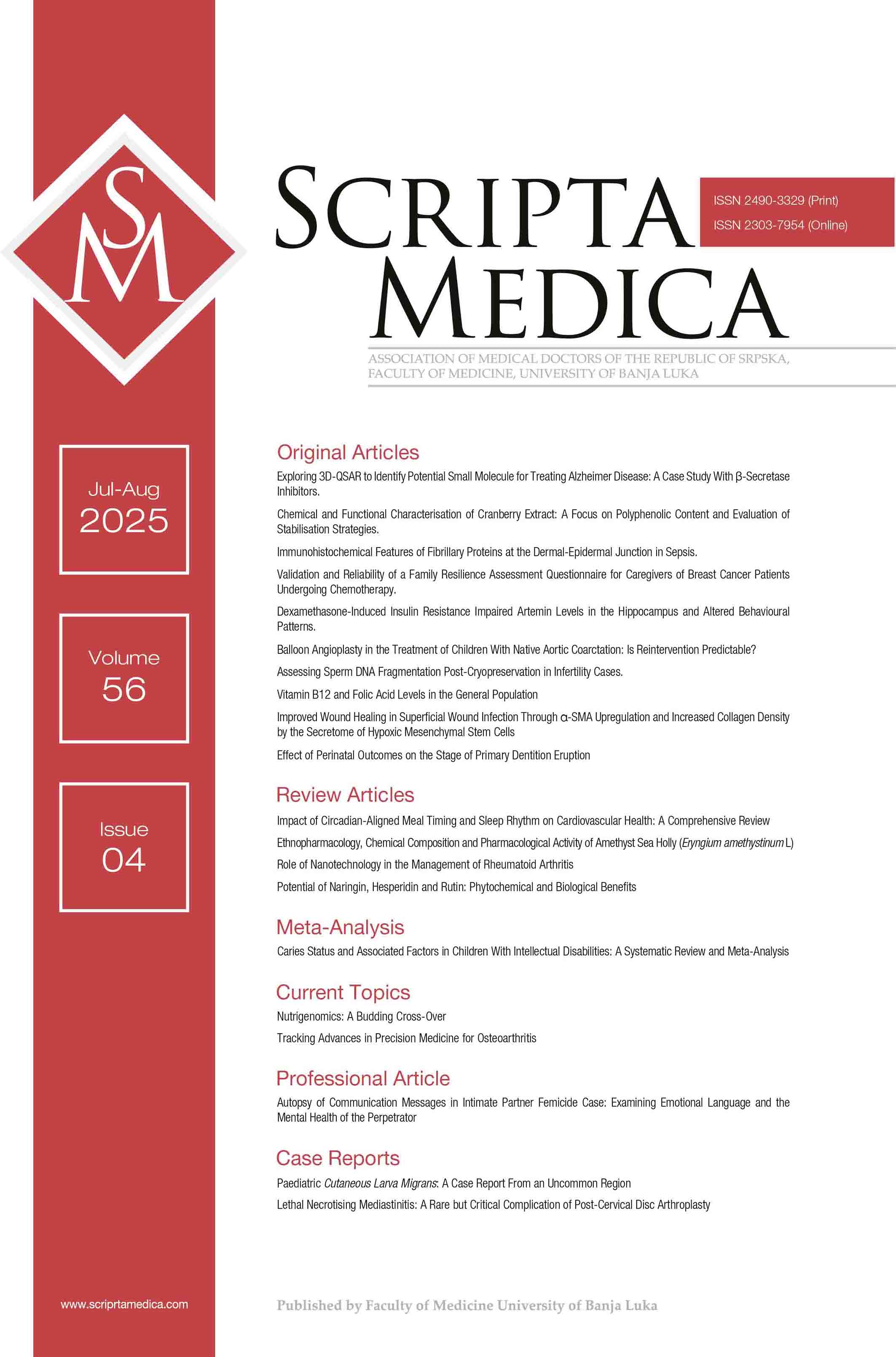
Validation and Reliability Testing of a Family Resilience Instrument for Breast Cancer Undergoing Chemotherapy Caregivers
Abstract
A
Background/Aim: Breast cancer, as the most prevalent non-communicable disease globally, imposes substantial emotional, economic and social burdens on patients and their families during chemotherapy treatment. Consequently, there is a critical need for instruments that assess family resilience. The aim of this study was to develop and evaluate a culturally appropriate family resilience assessment tool that explores the belief systems, organisational frameworks and communication strategies of families supporting breast cancer patients undergoing chemotherapy.
Methods: A pilot study was conducted involving 76 families of breast cancer patients undergoing chemotherapy. The inclusion criteria were: caregiving for a duration exceeding one month, being at least eighteen years of age, willingness to cooperate and literacy. Data collection occurred from September to December 2024, utilising convenience sampling techniques. The questionnaire comprised sociodemographic information and three dimensions of resilience—belief system (13 items), organisational pattern (8 items) and communication process (11 items). Validity was assessed using Pearson's product-moment correlation, while reliability was determined through Cronbach's alpha. Statistical analyses were executed using SPSS Version 26.0.
Results: Most participants were middle-aged (40–59 years) with high school education, have undergone six or more chemotherapy sessions, were unemployed and used national health insurance (BPJS). Reliability analysis showed good internal consistency (Cronbach's alpha > 0.7). One item was invalid due to a low correlation with the overall score, while the rest were valid.
Conclusion: The questionnaire is valid and reliable for assessing family resilience during chemotherapy care for breast cancer patients, supporting future studies and treatments to enhance patient outcomes and quality of life.
References
Sung H, Ferlay J, Siegel RL, Laversanne M, Soerjomataram I, Jemal A, et al. Global cancer statistics 2020: GLOBOCAN estimates of incidence and mortality worldwide for 36 cancers in 185 countries. CA Cancer J Clin. 2021 May;71(3):209-49. doi: 10.3322/caac.21660.
Ministry of Health of the Republic of Indonesia. [Indonesian Health Profile 2021]. Ministry of Health of the Republic of Indonesia; 2021. Indonesian.
Cincidda C, Oliveri S, Sanchini V, Pravettoni G. The role of caregivers in the clinical pathway of patients newly diagnosed with breast and prostate cancer: A study protocol. Front Psychol. 2022;13. doi:10.3389/fpsyg.2022.962634.
Walsh F. Loss and resilience in the Time of COVID-19: meaning making, hope, and transcendence. Fam Process. 2020;59(3):898-911. doi: 10.1111/famp.12588.
Morgan SP, Lengacher CA, Rodriguez CS. Caregiver burden in caregivers of patients with advanced stage cancer: A concept analysis. Eur J Oncol Nurs. 2022;60:102152. doi: 10.1016/j.ejon.2022.102152.
Khazi F, Angolkar M, Bhise R, Ahmed I. Psychosocial impact at diagnosis and coping strategies among women with breast cancer-A qualitative study. Clin Epidemiol Glob Heal. 2023;22:101343. doi: 10.1016/j.cegh.2023.101343.
Kim K, Park H. Factors affecting anxiety and depression in young breast cancer survivors undergoing radiotherapy. Eur J Oncol Nurs. 2021;50:101898. doi: 10.1016/j.ejon.2021.101898.
Guhan M, Crane SM, Valerius LS, Cruz D, Smith BD, Woodward WA, et al. Patient interest in exploring nonsurgical treatment approaches for early-stage breast cancer: a qualitative study. Int J Radiat Oncol Biol Phys. 2024 Feb 1;118(2):443-54. doi: 10.1016/j.ijrobp.2023.08.065.
Scaria L, Devassy SM, Joubert L. Familial and social implications of breast and gynaecological cancer in Kerala, India. Curr Probl Cancer. 2024;49:101080. doi: 10.1016/j.currproblcancer.2024.101080.
Arpaci T, Altay N. Qualitative analysis of school re-entry experiences of Turkish survivors of childhood and adolescent cancer: parental perspective. Semin Oncol Nurs. 2024;40(2):151613. doi: 10.1016/j.soncn.2024.151613.
Tulpin M, Scherrens AL, Van Driessche A, Verhofstadt LL, Kreicbergs U, Goubert L, et al. "A sincere 'how are you?' is already a sign of acknowledgement that you're there too." - Interview study on the support needs of adolescents and young adults (AYAs) living with a parent with cancer. Eur J Oncol Nurs. 2024 Jun;70:102602. doi: 10.1016/j.ejon.2024.102602.
Huang YY, Chen MJ, Zhang Y, Chen XW, Zhang LP, Dong CQ. Finding family resilience in adversity: A grounded theory of families with children diagnosed with leukaemia. J Clin Nurs. 2023;32(15-16):5160-72. doi:10.1111/jocn.16615.
Shao M, Yang H, Du R, Zhang M, Zhu J, Zhang H, et al. Family resilience in cancer treatment and key influencing factors: A systematic review. Eur J Oncol Nurs. 2023 Oct;66:102403. doi: 10.1016/j.ejon.2023.102403.
Ruiz-Rodríguez I, Hombrados-Mendieta I, Melguizo-Garín A, Martos-Méndez MJ. The importance of social support, optimism and resilience on the quality of life of cancer patients. Front Psychol. 2022;13. doi:10.3389/fpsyg.2022.833176.
Kuang Y, Wang M, Yu NX, Jia S, Guan T, Zhang X, et al. Family resilience of patients requiring long-term care: A meta-synthesis of qualitative studies. J Clin Nurs. 2023 Jul;32(13-14):4159-75. doi: 10.1111/jocn.16500.
He Y, Liu X, Lin T, Guo X, Chen J. The mediating role of perceived stress in the association between family resilience and psychological distress among gynecological cancer patients: a cross-sectional study. BMC Psychiatry. 2024;24(1):622. doi:10.1186/s12888-024-06060-z.
Ulibarri-Ochoa A, Macía P, Ruiz-de-Alegría B, García-Vivar C, Iraurgi I. The role of resilience and coping strategies as predictors of well-being in breast cancer patients. Eur J Oncol Nurs. 2024;71:102620. doi: 10.1016/j.ejon.2024.102620.
Adresi Y, Balci H. Resilience in women who underwent breast cancer surgery. Akdeniz Med J. 2022:347-53. doi: 10.53394/akd.1059556.
Zhou K, Fan N, Wang X, Wang W, Han D, Li X. Perceived social support and coping style as mediators between resilience and health-related quality of life in women newly diagnosed with breast cancer: a cross-sectional study. BMC Womens Health. 2022;22:1-9. doi: 10.1186/s12905-022-01783-1.
Zhang Y, Ding Y, Liu C, Li J, Wang Q, Li Y, et al. Relationships among perceived social support, family resilience, and caregiver burden in lung cancer families: a mediating model. Semin Oncol Nurs. 2023 Jun;39(3):151356. doi: 10.1016/j.soncn.2022.151356.
Qiu X, Mao J, Wang C, Yang X, Li Q. Family resilience and its influencing factors in patients with cancer and their family members: a systematic review. J Clin Nurs. 2024. doi: 10.1111/jocn.17485.
Hammood ZD, Salih AM, Othman S, Abdulla BA, Mohammed SH, Kakamad FH, et al. Breast cancer recurrence 27 years after full recovery; A case report with literature review. Int J Surg Case Rep. 2022 Mar;92:106827. doi: 10.1016/j.ijscr.2022.106827.
Clifton K, Gao F, Jabbari J, Van Aman M, Dulle P, Hanson J, Wildes TM. Loneliness, social isolation, and social support in older adults with active cancer during the COVID-19 pandemic. J Geriatr Oncol. 2022 Nov;13(8):1122-31. doi: 10.1016/j.jgo.2022.08.003.
Ke J, Lin J, Lin X, Chen W ti, Huang F. Dyadic effects of family resilience on quality of life in patients with lung cancer and spousal caregivers: The mediating role of dyadic coping. Eur J Oncol Nurs. 2023;66(May):102400. doi:10.1016/j.ejon.2023.102400.
Cui PP, Shi JX, Li SF, Getu MA, Wang RB, Chen CY. Family resilience and its influencing factors among advanced cancer patients and their family caregivers: a multilevel modeling analysis. BMC Cancer. 2023;23(1):1-13. doi:10.1186/s12885-023-11101-z.
Luthar SS, Cicchetti D, Becker B. The construct of resilience: a critical evaluation and guidelines for future work. Child Dev. 2000;71(3):543-62. doi: 10.1111/1467-8624.00164.
Khalifa MF, Al Ghuraibawi ZAG, Hade IM, Ali Mahdi M. Evaluation of quality of life for women with breast cancer. Scr Medica (Banja Luka). 2024;55(1):115-8. doi: 10.5937/scriptamed55-47068.
Toledano-Toledano F, Moral de la Rubia J, Broche-Pérez Y, Domínguez-Guedea MT, Granados-García V. The measurement scale of resilience among family caregivers of children with cancer: a psychometric evaluation. BMC Public Health. 2019;19(1):1164. doi:10.1186/s12889-019-7512-8.
Rezaei M, Keyvanloo Shahrestanaki S, Mohammadzadeh R, Aghili MS, Rajabi M, Abbasi M, et al. Caregiving consequences in cancer family caregivers: a narrative review of qualitative studies. Front Public Health. 2024 Mar 22;12:1334842. doi: 10.3389/fpubh.2024.1334842.
Walsh F. Family Resilience: A framework for clinical practice. Fam Process. 2003;42(I):1-18. doi: 10.1111/j.1545-5300.2003.00001.x.
Creswell JW, Creswell JD. Research design qualitative, quantitative, and mixed methods approaches. 5th Ed. Thousand Oaks, CA: SAGE; 2018.
Denise F. Polit CTB. Essentials of nursing research. Appraising evidence for nursing practice. 7th Ed. Philadelphia, PA: Lippincott Williams & Wilkins 2010.
Sugiyono PD. [Qualitative quantitative research methods and R&D]. Alfabeta; 2019. Indonesian.
Cousins LA, Kalapurakkel S, Cohen LL, Simons LE. Topical review: resilience resources and mechanisms in pediatric chronic pain. J Pediatr Psychol. 2015;40(9):840-5. doi:10.1093/jpepsy/jsv037.
Dong C, Wu Q, Pan Y, Yan Q, Xu R, Zhang R. Family resilience and its association with psychosocial adjustment of children with chronic illness: a latent profile analysis. J Pediatr Nurs. 2021;60:e6-e12. doi: 10.1016/j.pedn.2021.02.010.
Rocchi S, Ghidelli C, Burro R, Vitacca M, Scalvini S, Della Vedova AM, et al. The Walsh Family Resilience Questionnaire: the Italian version. Neuropsychiatr Dis Treat. 2017 Dec 14;13:2987-99. doi: 10.2147/NDT.S147315.
Germer CK, Siegel RD, Fulton PR. Foundations of a family resilience approach. In: Walsh G, Ed. Strengthening family resilience. 3rd Ed. New York, NY: Guilford Publications; 2016; pp. 3-21.
Nadrowska N, Błażek M, Lewandowska-Walter A, Błażek W, Zdun-Ryżewska A. Walsh Family Resilience Questionnaire—Polish Adaptation (WFRQ-PL). Int J Environ Res Public Health. 2022;19(7):1-13. doi:10.3390/ijerph19074197.
Sun X, Wang Y, Lu X, Zhang S, Zhang Y. Factors influencing family resilience in adult patients with acute leukemia undergoing chemotherapy: A qualitative study. Asia-Pacific J Oncol Nurs. 2024;11(4):100389. doi: 10.1016/j.apjon.2024.100389.
Reader SK, Pantaleao A, Keeler CN, Ruppe NM, Kazak AE, Rash-Ellis DL, et al. Family resilience from the perspective of caregivers of youth with sickle cell disease. J Pediatr Hematol Oncol. 2020 Mar;42(2):100-6. doi: 10.1097/MPH.0000000000001682.
Manning LK, Bouchard L. Encounters with adversity: A framework for understanding resilience in later life. Aging Ment Health. 2020;24(7):1108-15. doi:10.1080/13607863.2019.1594162.
Zhu W. The Impact of social support on the mental health of cancer patients: evidence from China. Psycho-Oncologie. 2024;18(1):69-77. doi: 10.32604/po.2023.046593.
Dean M, Baker JT, Reblin M, Hintz EA, Vadaparampil ST, Haskins C, et al. Feasibility, acceptability, and outcomes of a pilot intervention facilitating communication about family building between patients with inherited cancer risk and their partners. PEC Innov. 2022 Jun 1;1:100055. doi: 10.1016/j.pecinn.2022.100055.
- Authors retain copyright and grant the journal right of first publication with the work simultaneously licensed under a Creative Commons Attribution License that allows others to share the work with an acknowledgement of the work's authorship and initial publication in this journal.
- Authors are able to enter into separate, additional contractual arrangements for the non-exclusive distribution of the journal's published version of the work (e.g., post it to an institutional repository or publish it in a book), with an acknowledgement of its initial publication in this journal.
- Authors are permitted and encouraged to post their work online (e.g., in institutional repositories or on their website) prior to and during the submission process, as it can lead to productive exchanges, as well as earlier and greater citation of published work (See The Effect of Open Access).