
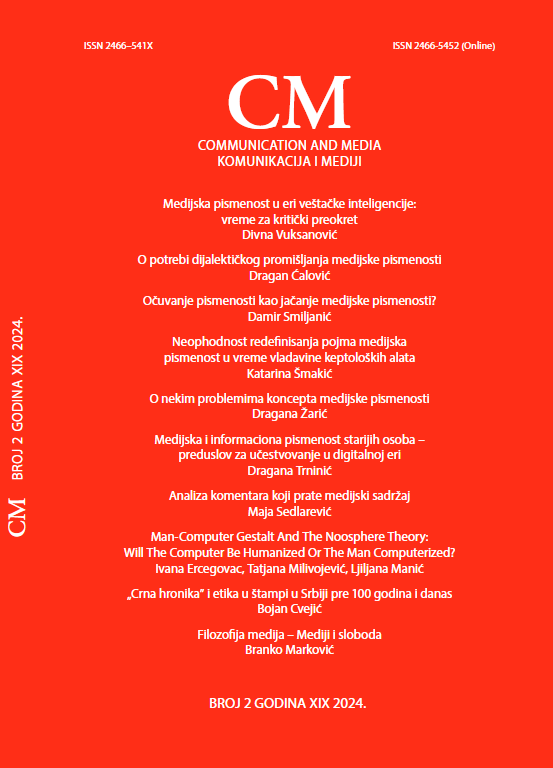
The The necessity of redefining the concept of media literacy in the era of captological tools
Abstract
Numerous definitions of the term media literacy aim at different areas of literacy in the media space, from its basic concept, i.e. the individual's ability to create media content and to understand it, up to the metalanguage of the media themselves and critical thinking of their content. Democratic societies have lost awareness of the importance of terms such as "manipulation" or "propaganda", these terms today sound archaic and as if they have no relation to current time, also we associate them with historical events and think that they have disappeared, but the real truth is that they have essentially changed their forms. Snuggled down in our stereo reality, relying on the protection provided by democratic procedures, we are living in an unreal world that is far from our reality, and our reality is pure capitalism that does not choose means when it comes to the fight for profit. Manipulation and propaganda have taken on a completely new form and a new tool that uses computer programs as a technology for persuasion, and the question is following: does the user's choice is his own conditioned by the media message or is the user psychologically changed so that his response would be the way the computer software wanted it to be? Understanding the importance of interactive technologies and their impact on the change of minds, attitudes and values of the audience, as well as their impact on changing behavior and reliability in predicting it, is nowadays more important than just thinking about the concrete definition of media literacy. The scientific field known as captology, the use of technology for persuasion, uses existing knowledge from social psychology, communication studies, marketing and other fields, combined with the development of new computer software in order to elicit predictable user responses. If we say that the user is manipulated by computer programs, we will not give a detailed description of this kind of user instruction, because manipulation is seduction and giving certain disinformation, influencing facts, while captology does it on a much higher level, influencing human instincts and the unconscious in humans, and it purposefully provokes the user's already suggested responses. Captology examine those computer programs whose intention is to contain algorithms that, based on data from other disciplines such as social psychology and marketing, will be incorporated into them, and that the intent of persuasion will be part of that product itself. Captology is focused on change of behavior or attitude due to human-computer interaction, rather than through computer-mediated communication. The behavioral techniques used today have been converted into algorithms that predict with great precision the outcomes of the user's actions, create the user's needs and trap him in the magic circle. The necessity of redefining the term media literacy is extremely important nowadays, raising awareness of the importance of captology and incorporating it into media literacy, as well as research in the field of practical application of captological tools today, requires the necessity of continuing research in this new scientific discipline.
References
Altbach (2006): Philip Altbach, The dilemmas of ranking, International Higher Education, 42.
Altiser (2009): Luj Altiser, Ideologija i državni ideološki aparati (Beleške za istraživanje), Karpos.
Bass, Riggio (2006): Bernard M. Bass, Ronald E. Riggio, Transformational Leadership (second edition), Mahwah, NJ: Erlbaum. Bernays (1928): Edward Bernays, Propaganda, http://wikispooks.com/w/images/1/1f/Propaganda.pdf, posećeno 10. 12. 2012.
Berdichevsky Daniel, Neuenschwander Erik, Toward an Ethnics of Persuasive Technology, COMMUNICATIONS OF THE ACM Vol. 42, No. 5 May 1999.
Bostrom, N., “The Transhumanist FAQ”, Faculty of Philosophy Oxford University, Published by the World Transhumanist Association, Version 2.1., 2003.
Breton (2000): Filip Breton, Izmanipulisana reč, Beograd: Clio.
Bubonjić (2010): Mladen Bubonjić, Sajber svetska alegorijska paradigma nove civilizacije, u: Časopis za upravljanje komuniciranjem, broj 17, godina V, Beograd: Fakultet političkih nauka Univerziteta u Beogradu.
Callaghan, McPhail, Yau (1995): M. Callaghan, J. McPhail, O. H. M. Yau, Dimensions of a relationship marketing orientation: an empirical exposition, Proceedings of the Seventh Biannual World Marketing Congress, Vol. VII‒II, Melbourne.
Callahan (2006): Ewa Callahan, Cultural Similarities and Differences in the Design of University Web Sites, Journal of Computer-Mediated Communication, doi:10.1111/j.1468-2958.2006.00012.x.
Fogg, Brian J. Persuasive technology: Using computers to change what we think and do. San Francisco: Kaufmann, 2003.
Fogg, B.J. (2002) Persuasive Technology: Using Computers to Change What We Think and Do. Ubiquity, 2002, 2. http://dx.doi.org/10.1145/764008.763957.
Fogg, B.J., (1999), Persuasive Technologies. Communications of the ACM, Volume 42, Issue 5.
Gone (1998): Žak Gone, Obrazovanje i mediji, Beograd: Clio.
Habermas (1987): Jürgen Habermas, The Idea of the University: Learning Processes, preveo John R. Blazek, New German Critique, sv. 41, Special Issue on the Critiques of the Enlightenment (Spring–Summer 1987), Ithaca, New York: Cornell University.
Hartli (2007): Džon Hartli (prir.), Kreativne industrije, Beograd: Clio.
Illouz (2007): Eva Illouz, Cold Intimacies, The Making of Emotional Capitalism, Oxford and Malden, MA: Polity Press.
Jaspers (2003): Karl Jaspers, Ideja univerziteta, Beograd: Plato.
Jaspers (1987): Karl Jaspers, Filozofska autobiografija, Novi Sad: Bratstvo i jedinstvo.
Jevtović (2003): Zoran Jevtović, Javno mnenje i politika, Beograd: Mas media.
King Phillip, Terster Jason (1999), The Landscape of Persuasive Technologies, Communications of the ACM, Volume 42, Issue 5, p.38.
Journal of Media Literacy Education. The official publication of the National Association for Media Literacy Educaton (NAMLE).
Le Bon (1989): Gustave le Bon, Psihologija gomila, Zagreb: Globus.
Livingstone, Sonia (2004) What is media literacy? Intermedia, 32 (3).
Malik, Sajjad (2008) Media Literacy and Its Importance, published by Society for Alternative Media and Research with coopration of Friedrich Ebert Stiftung (FES) and printed by Manzil Printers Posh Arcade, G-9 Markaz, Islamabad.
Manovich (2001): Lev Manovich, The Language of New Media, Massachusetts:MIT.
Matulić, Т., Metamorfoze kulture, Tertium mullenium, ISBN 9789-5324-1161-14, CIP 86343, Zagreb, 2009.
Martens, H. (2010). Evaluating media literacy education: Concepts, theories, and future directions. Journal of Media Literacy Education, 2(1).
Potter, W. J. (2022). Analysis of definitions of media literacy. Journal of Media Literacy Education, 14(2).
Potter, J. (2022). Analysis of definitions of media literacy. Journal of Media Literacy Education Pre-Prints. Retrieved from https://digitalcommons.uri.edu/jmle-preprints/41.
Predavec, D., Kaptologija inteligentnih sustava, Thesis nr. E697, Zagreb University of Applied Sciences, Polytechnic specialist graduate studies - Electrical Engineering department, Intelligent Systems course, mentor: Ph.D. Zdenko Balaž, mag.ing.el., Zagreb, March, 2017.
Radojković Miroljub, Digitalni mediji u Srbiji – Koristi i opasnosti, Politeia, 2017, god. 7, br.13.
Rosenbaum, J. E., Beentjes, J. W. J., & Konig, R. P. (2008). Mapping media literacy key concepts and future directions. Annals of the International Communication Association, 32(1).
Univerzalna deklaracija o ljudskim pravima –https://www.poverenik.rs/images/stories/
dokumentacija-nova/medjunarodnadokumenta/UJEDINJENENACIJE/Univerzalnadeklaracijacir
.pdf.
Vuksanović Divna, ESTETSKO I STVARNO:MEDIJI–UMETNOST–ŽIVOT, Zbornik radova FDU br. 37, Fakultet dramskih umetnosti u Beogradu, ISSN 1450–5681, Beograd, 2020.
Copyright
Authors retain copyright of the published papers and grant to the publisher the non-exclusive right to publish the article, to be cited as its original publisher in case of reuse, and to distribute it in all forms and media.
Licensing
The published articles will be distributed under the Creative Commons Attribution ShareAlike 4.0 International license (CC BY-SA). It is allowed to copy and redistribute the material in any medium or format, and remix, transform, and build upon it for any purpose, even commercially, as long as appropriate credit is given to the original author(s), a link to the license is provided, it is indicated if changes were made and the new work is distributed under the same license as the original.
Users are required to provide full bibliographic description of the original publication (authors, article title, journal title, volume, issue, pages), as well as its DOI code. In electronic publishing, users are also required to link the content with both the original article published in CM: Communication and Media and the licence used.
Authors are able to enter into separate, additional contractual arrangements for the non-exclusive distribution of the journal's published version of the work (e.g., post it to an institutional repository or publish it in a book), with an acknowledgement of its initial publication in this journal.
Self-archiving policy
Authors are permitted to deposit author’s publisher's version (PDF) of their work in an institutional repository, subject-based repository, author's personal website (including social networking sites, such as ResearchGate, Academia.edu, etc.), at any time after publication.
Full bibliographic information (authors, article title, journal title, volume, issue, pages) about the original publication must be provided and links must be made to the article's DOI and the license.
Disclaimer
The views expressed in the published works do not express the views of the Editors and the Editorial Staff. The authors take legal and moral responsibility for the ideas expressed in the articles. Publisher shall have no liability in the event of issuance of any claims for damages. The Publisher will not be held legally responsible should there be any claims for compensation.