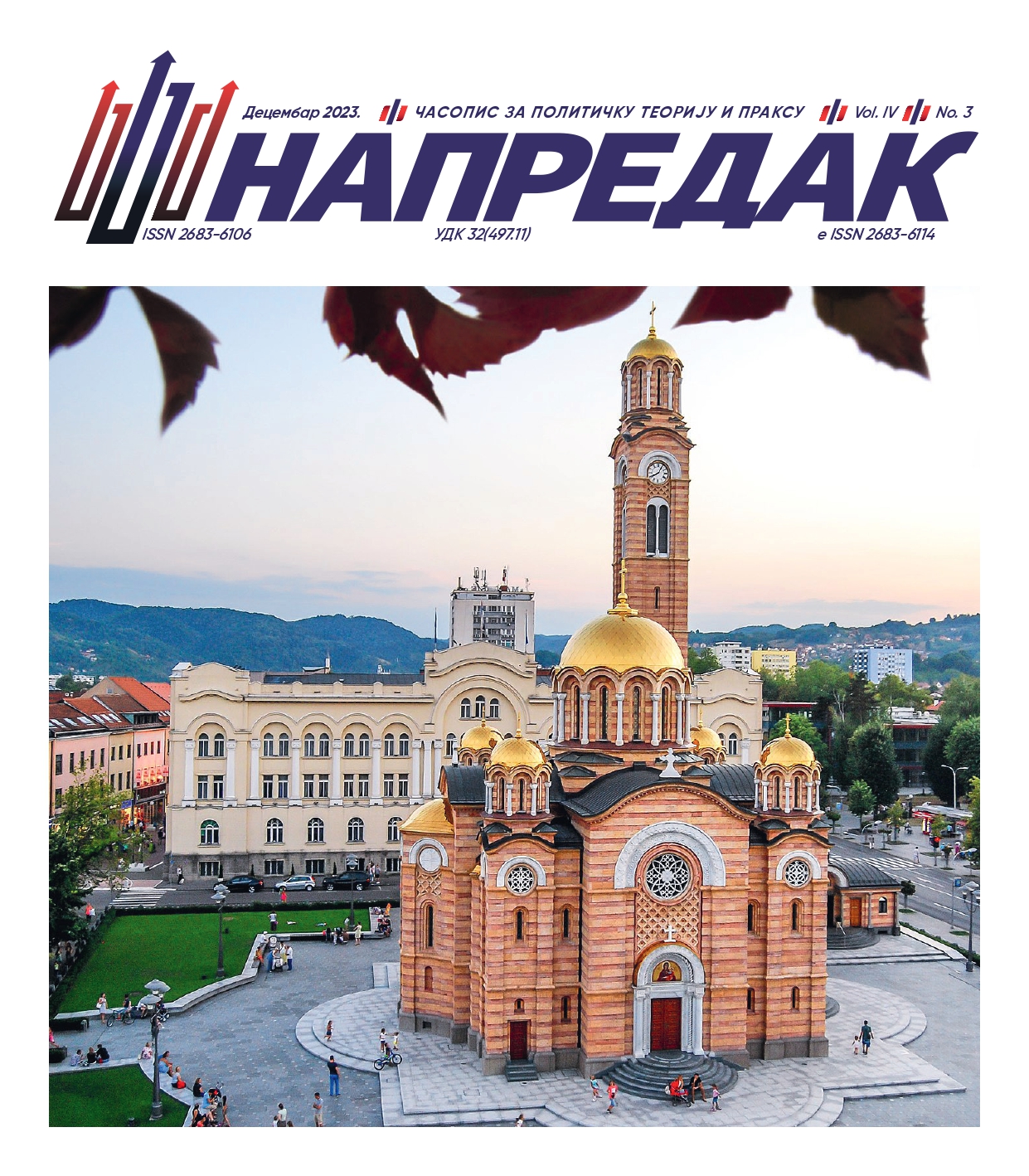
Босна и Херцеговина између међународних интервенција и распада
Sažetak
Процес изградње државности Босне и Херцеговине мимо одредаба Дејтонског мировног споразума, Запад спроводи већ 28 година кроз различите форме. Оно што нису успјели постићи у Дејтону, наставили су силом, кажњавањима, прегласавањима страних судија, наметањима високих представника, преносом надлежности и суспендовањем демократије. Циљеви су им били разградња Дејтона и јачање заједничког нивоа власти науштрб аутономије ентитета, али умјесто унитарне БиХ, добили су климав протекторат. Данас Босна и Херцеговина има огроман несклад између дејтонског уставног система и постојећег стања након деценија различитих страних интервенција у политички и правни систем БиХ. Недостатак потенцијалних рјешења за излазак из објективно нефункционалног стања додатно су појачали утисак да се БиХ креће у правцу дисолуције. Тврдња да су интервенције дијела међународне заједнице у БиХ појачале потенцијал за распад ове државне заједнице, основни је фокус овог рада.
Reference
Antić, Č., Kecmanović, N. (2016). History of the Republic Srpska. Beograd: Nedeljnik, Banjaluka: Službeni glasnik Republike Srpske. [In Serbian]
Ashdown, P. (2007). Swords and Ploughshares: Bringing Peace to the 21st Century. London: Orion.
Ashdown, P. (2010). A Fortunate Life: The Autobiography of Paddy Ashdown. London: Aurum Press.
Banning, T. (2014). The ’Bonn Powers’ of the High Representative in Bosnia Herzegovina: Tracing a Legal Figment. Goettingen Journal of International Law, VI (2), 259–302. Available at: https://www.gojil.eu/issues/62/62_article_banning.pdf.
Barnett, M. (2006). Building a Republican peace: Stabilizing states after War. International Security, XXX (4), 87–112. Available at: https://www.jstor.org/stable/4137530.
Baros, M. (2010, December 14). The High Representative for Bosnia and Herzegovina: A Requiem for Legality. EJIL: Talk! – Blog of the European Journal of International Law. Retrieved from: https://www.ejiltalk.org/the-high-representative-forbosnia-and-herzegovina-a-requiem-for-legality. Accessed: 29. 11. 2023.
Belloni, R. (2008). State Building and International Intervention in Bosnia. London: Routledge.
Bennett, C. (2016). Bosnia’s Paralysed Peace. London: Hurst & Co.
Blagojević, M. (2018). Chrestomathy of Achaerism Technology – A Chronicle of a National and Constitutional Pathology. Banjaluka: Službeni glasnik Republike Srpske. [In Serbian]
Brubaker, R. (1996). Nationalism reframed: Nationhood and the national question in the New Europe. New York: Cambridge University Press.
Caplan, R. (2005). International Governance of War-torn Territories: Rule and Reconstruction. Oxford: Oxford University Press.
Chandler, D. (2000). Bosnia: Faking Democracy After Dayton. London: Pluto Press.
Chandler, D. (2005). From Dayton to Europe. International Peacekeeping, XII (3), 336–349. DOI:10.1080/13533310500074077
Clausewitz, C. v. (2007). On War. New York: Oxford University Press.
Crawford, C. (2011). Bosnia: the Bonn Powers Crawl Away to Die. Retrieved from: http://charlescrawford.biz/2011/07/05/bosnia-the-bonn-powers-crawl-away-to-die. Accessed: 29. 11. 2023.
Downes, A. B. (2007). The Problem with Negotiated Settlements to Ethnic Civil Wars. In: M. Bloom and R. Licklider (eds). Living Together After Ethnic Cleansing: Exploring the Chaim Kaufmann Argument. New York: Routledge.
Ghali, B. B. (1992). An Agenda for Peace. New York: United Nations.
Ghali, B. B. (1995). Supplement to an Agenda for Peace. New York: United Nations.
Hayden, R. M. (1999). Blueprints for a House Divided: The Constitutional Logic of the Yugoslav Conflicts. Ann Arbor MI: University of Michigan Press.
Ignatieff, M. (2003). Empire Lite: Nation-building in Bosnia, Kosovo and Afghanistan. London: Penguin.
Kasapović, M. М. (2005). Bosnia and Herzegovina, divided society and unstable state. Zagreb: Politička kultura. [In Croatian]
Kaufmann, C. (1996). Possible and Impossible Solutions to Ethnic Civil Wars. International Security, XX (4), 136-175. Doi: https://doi.org/10.1162/isec.20.4.136
Kaufmann, C. D. (1999). When All Else Fails: Evaluating Population Transfers and Partition as Solutions to Ethnic Conflict. In: B. F. Walter and J. Snyder (eds). Civil Wars, Insecurity and Intervention. New York: Columbia University Press.
Kellas, J. G. (2004). Nationalist Politics in Europe – The Constitutional and Electoral Dimensions. London: Palgrave MacMillan.
Kecmanović, N., Vranješ, A., Budimir, Ž. (2021). Rise of An Idea – Freedom and Autonomy of the Republic Srpska and the Role of Milorad Dodik. Beograd: Službeni glasnik. [In Serbian]
Knaus, G., Martin, F. (2003). Travails of the European Raj. Journal of Democracy. XIV (3), 60–74. Available at: https://www.journalofdemocracy.org/wp-content/uploads/2012/04/KnausandMartin.pdf
Leroux-Martin, P. (2014). Diplomatic Counterinsurgency: Lessons from Bosnia and Herzegovina. New York: Cambridge University press.
Merdzanovic, A. (2015). Democracy by Decree – Prospects and Limits of Imposed Consociational Democracy in Bosnia and Herzegovina. Stuttgart: Ibidem Press
O’Hanlon, M. (1998). Turning the Bosnia Ceasefire into Peace. The Brookings Review, XVI (1), 41–44. Doi: https://doi.org/10.2307/20080768
Orr, R. C. (2004). The United States as Nation Builder. In: R. Orr (ed.) Winning the Peace: An American Strategy for Postconflict Reconstruction (3–18). Washington: Center for Strategic and International Studies.
Paris, R. (2004). At War’s End: Building Peace After Civil Conflict. New York: Cambridge University Press
Parish, M. (2009). A Free City in the Balkans: Reconstructing a Divided Society in Bosnia. London: I. B. Tauris.
Parish, M. (2017). A free city in the Balkans: reconstructing a divided society in Bosnia. Brčko: Brčanski demokratski forum. [In Bosnian]
Pasch, P. (2012). Bosnia and Hercegovina 2025: Scenarios on Future Developments. Sarajevo: Friedrich Ebert Stiftung. [In Bosnian]
PIC Bonn Conclusions. (1998). Bosnia and Herzegovina 1998: Self-sustaining Structures. Retrieved from: http://www.ohr.int/pic-bonn-conclusions/?print=pdf. Accessed: 30.11.2023.
Sebastián-Aparicio, S. (2014). Post-War Statebuilding and Constitutional Reform – Beyond Dayton in Bosnia. London:Palgrave Macmillan.
Stokes, G. (2003). Solving the Wars of Yugoslav Secession. In: N. M. Mainark and H. Case (eds). Yugoslavia and Its Historians: Understanding the Balkan Wars of the 1990s. Stanford CA: Stanford University Press.
Waters, T. W. (2004). Contemplating Failure and Creating Alternatives in the Balkans: Bosnia’s Peoples, Democracy, and the Shape of Self-Determination. Yale International Law Journal, Vol. XXIX, 423–475. Available at: https://www.repository.law.indiana.edu/cgi/viewcontent.cgi?article=1324&context=facpub.
Westendorp, C. (1997). Interview: Carlos Westendorp, High Representative in BiH. Slobodna Bosna, 30 November 1997. Downloaded from: http://www.ohr.int/?p=57486. Accessed on 30 November 2023.
Woodward, S. L. (1999). How Not to End a Civil War. In: Snyder, J. and Walter, B. (eds). Civil War, Insecurity, and Intervention. New York: Columbia University Press.
Zaum, D. (2007). The Sovereignty Paradox: The Norms and Politics of International Statebuilding. Oxford: Oxford University Press.