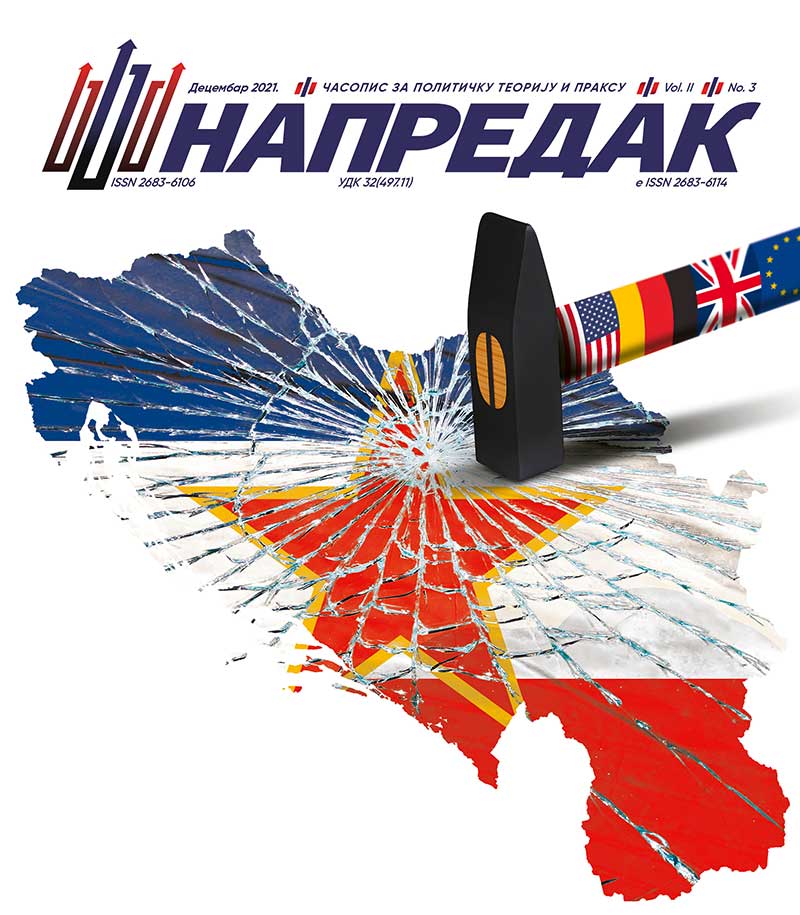
Geopolitical reasons for the break-up of Tito’s Yugoslavia in the context of the international hegemony of the USA
Abstract
We will present the main geopolitical reasons for the creation of the Kingdom of the SCS-Yugoslavia and follow their effect until the moment those reasons led to the decision of the Neo-Atlanticists to liquidate Broz’s SFR Yugoslavia as a state and geopolitical project of the Entente forces. The process of the disintegration of the SFRY proceeded quickly and decisively with the imposition of new geopolitical interests of Neo-Atlanticism and foreign policy priorities. At that time, a new hegemon in the monopolar political order emerged, following the downfall of bipolarism that had dominated the world stage for more than four decades. All the geopolitical transgressions of the USA, both in the zones of the post-Soviet order of power and in the territorial area of the post-Yugoslav geopolitical experiment, produced a mutilation of the statehood, demography, territory, identity, language, culture and economy of Serbs in the area.
References
Avramov, S. (1998). The Trilateral Commission. Veternik: Idij. [In Serbian]
Bataković, D. (2018). The Balkan Piedmont: Serbia and the Yugoslav Question. In: The history of a utopia. Belgrade: Catena Mundi. [In Serbian]
Bogetić, D. (2000). Yugoslavia and the West 1952–1955. Belgrade: Službeni list SRJ. [In Serbian]
Despotović, Lj. (2019). The geopolitics of Svetosavlje. Sremski Karlovci: Kairos. [In Serbian]
Despotović, Lj., Glišin, V. (2020). The American militarization of Europe at the beginning of the 21st century as a malignant explication of the continuity of Anglo-Saxon geopolitical doctrine. Politika nacionalne bezbednosti 2/2020. Belgrade: Institut za političke studije. [In Serbian]
Despotović, Lj., Glišin, V. (2021). Contemporary international relations and geopolitics. Sremski Karlovci: Kairos. [In Serbian]
Despotović, Lj., Glišin, V. (2021a). The geopolitical interests and political concepts of the formation of the two Yugoslavias and the reasons for their breakdown. In: D. Antić (ed) Leskovački zbornik LXI. Leskovac: Narodni muzej Leskovac. [In Serbian]
Dešner, K. (2021). The Politics of the Papacy in the 20th Century. Belgrade: Catena Mundi. [In Serbian]
Dević, N. (2021). For the party and Tito: The Partisan movement in Serbia 1941–1944. Belgrade: Službeni glasnik. [In Serbian]
Ekmečić, M. (1989). The Creation of Yugoslavia 1790–1918. Belgrade: Prosveta. [In Serbian]
Ekmečić, M. (2002). Essays from history. Belgrade: Službeni list SRJ. [In Serbian]
Ekmečić, M. (2014). The war goals of Serbia 1914. Belgrade: Filip Višnjić. [In Serbian]
Ekmečić, M. (2017). The long movement between slaughter and plowing – History of the Serbs in the new century (1492–1992). Belgrade: Evro Book. [In Serbian]
Mackinder, H. (1942). Democratic Ideals and Reality. Washington DC: National Defense University Press. [In English]
Mitrović, A. (2018). The war goals of the Central Powers and the Yugoslav question 1914–1918. In: The history of a utopia. Belgrade: Catena Mundi. [In Serbian]
Orel, K. (2012). Central Europe: from idea to history. Belgrade: Clio. [In Serbian]
Proroković, D. (2014). German geopolitics and the Balkans: on the goals of Central European continentalism. Belgrade: Catena Mundi. [In Serbian]
Vudvord, S. (1997). Balkan Tragedy: Chaos and Dissolution after the Cold War. Belgrade: Filip Višnjić. [In Serbian]
Živen, E. (2019). The west wall did not fall. Novi Sad: Nova Evropa. [In Serbian]