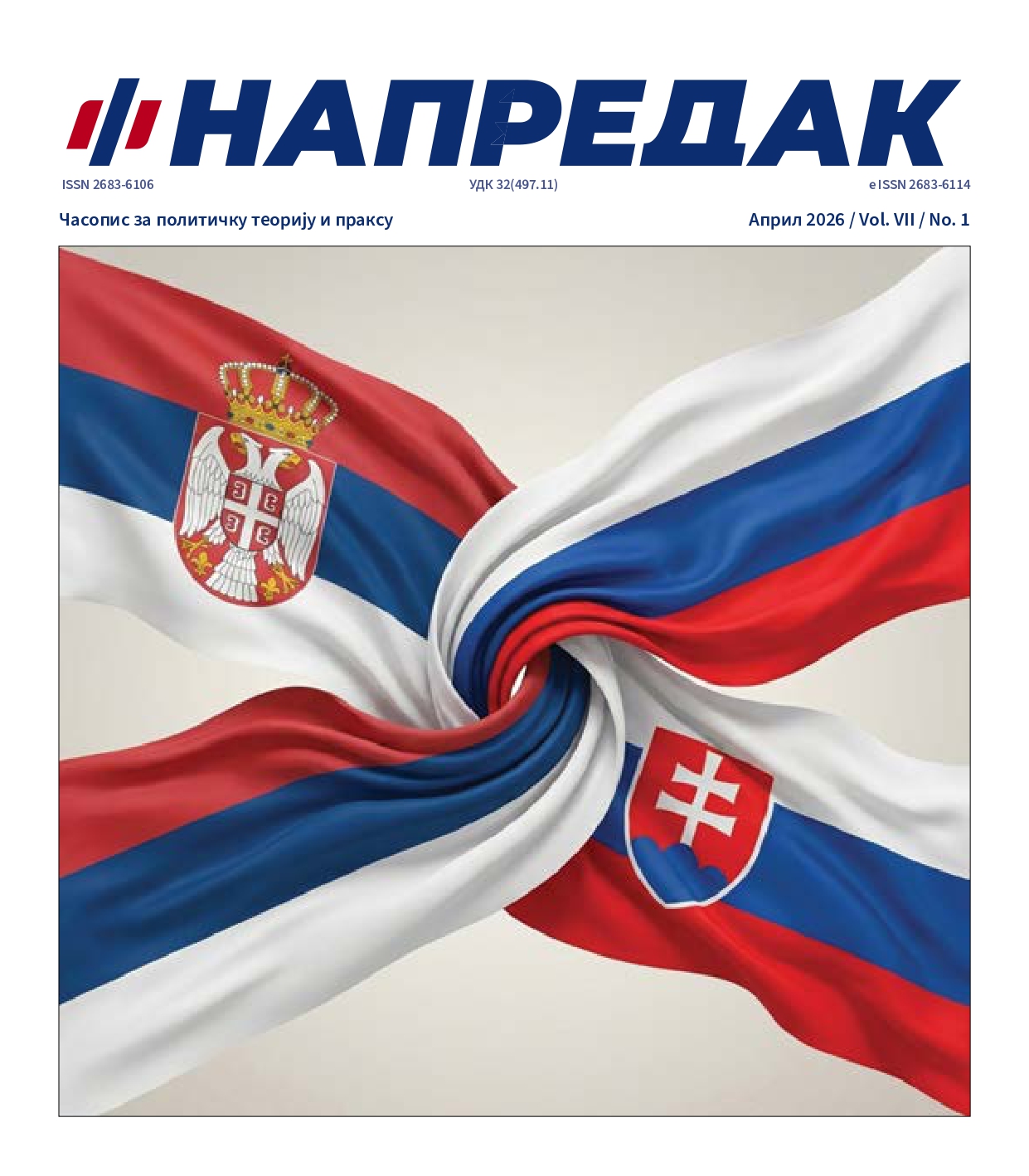
Serbs and Slovaks, Matica Srpska and Matica Slovenská: Two centuries of trials and experiences
Abstract
Two Slavic peoples, Serbs and Slovaks, Slovaks and Serbs, serve as a good example of nations with close common origins, who, throughout their existence, have not easily forgotten this shared heritage. This common origin enables them even today, after many centuries, to understand each other well and to have meaningful dialogue. A developed consciousness of kinship, rooted as much in the facts of common origin as in the realities of mutual understanding, allows these two peoples not only to examine the obscure and unclear events of the past but also to project related visions of the future. Only by combining these two profound and distant temporal dimensions, expressed in the intersection we call the ever-relevant present, should one seek to construct one’s collective, national destiny and concrete historical reality. Such construction, in turn, should not rely solely on adapting to general, global, externally imposed circumstances but also on actively shaping a sense of meaning that reveals itself to a Slavic people as a credible value of human life, the kind of life that is possible in this time and in this world.
References
Chronicle of Matica srpska: First issue [Letopis Matice srpske: Objavlenije i Prva častica] (1823–1824). Facsimile edition (ed. I. Negrišorac). Novi Sad: Matica srpska, 2023. [In Serbian]
Chronicle of Matica srpska: Second and third issue [Letopis Matice srpske: Druga i treća častica] (1825). Facsimile edition (ed. I. Negrišorac). Novi Sad: Matica srpska, 2024. [In Serbian]
Eliáš, M. (2010). From the history of Slavic Maticas of nations. Martin: Matica slovenská. [In Slovak]
Kovaček, B. (2006). Jovan Đorđević. Novi Sad: Matica srpska. [In Serbian]
Kovijanić, R. (1973). Serbian writers in Bratislava and Modra in the 18th century. Novi Sad: Matica srpska. [In Serbian]
Kovijanić, R. (1979). Serbian romanticists in Slovakia. Novi Sad: Matica srpska. [In Serbian]
Maletin, M. (1968). Content of the Chronicle of Matica srpska 1825–1950: Content by authors. Novi Sad: Matica srpska. [In Serbian]
Miletić, S. (1999). Collected works, vol. I (eds. Č. Popov & D. Mikavica). Beograd: Zavod za udžbenike i nastavna sredstva. [In Serbian]
Milisavac, Ž. (1986). History of Matica srpska: Part I: 1826–1864. Novi Sad: Matica srpska. [In Serbian]
Milisavac, Ž. (1992). History of Matica srpska: Part II: 1864–1880. Novi Sad: Matica srpska. [In Serbian]
Milisavac, Ž. (2001). History of Matica srpska: Part III: 1880–1918. Novi Sad: Matica srpska. [In Serbian]
Negrišorac, I. (2026). The Vow of Matica srpska: A guide to the oldest cultural institution. Novi Sad: Matica srpska. [In Serbian]
Pamätnica – Spomentnica – Pamjatnaja kniga: 4. kongres matíc a inštitúcií slovanských národov (2020). (eds. M. Gešper & Z. Pavelcová). Martin: Matica slovenská. [In Slovak]
Pavel Jozef Šafarik (1795–1861) (1963). (ed. Đ. Sp. Radojičić). Novi Sad: Matica srpska. [In Serbian]
Pavel Jozef Šafarik: Life and work (1996). (ed. M. D. Stefanović & M. Harpanj). Novi Sad: Matica srpska. [In Serbian]
Popov, D. (2001). History of Matica srpska: Part IV: 1918–1941. Novi Sad: Matica srpska. [In Serbian]
Rajić, J. (2002). History of various Slavic peoples, especially Bulgarians, Croats and Serbs, vol. I–IV (ed. I. Negrišorac). Novi Sad: Matica srpska – Orfeus. [In Bulgarian]
Serbske letopisi, No. 10. (1827). [In Serbian]
Šafarik, P. J. (1824). Character of the Slavic people in general. Serbske letopisi, prva častica, vol. 1, 64–99. [In Serbian]
Taylor, A. J. (2001). The Habsburg Monarchy 1809–1918: A History of the Austrian Empire and Austria-Hungary (translation M. Nikolajević). Beograd: Clio. [In Serbian]
That Way, Not Otherwise (Tako, a ne inače): Commemorative volume on the 150th anniversary of the transfer of Matica srpska from Pest to Novi Sad (2014). (eds. D. Stanić & Đ. Đurić). Novi Sad: Matica srpska. [In Serbian]